AI crawlers
Recognize requests that claim to be AI crawlers and verify them; allow, block, challenge or charge them per crawler or operator; manage robots.txt; see crawler traffic per site.
Concepts
| Term | Definition |
|---|---|
| Catalogue | The crawler list built into the console: operator, purpose, User-Agent tokens, how to verify. It changes with console releases; nodes get it in their configuration and never download it at runtime. |
| Claim | The User-Agent contains one of a crawler's tokens (case-insensitive; with several matches the longest token wins, then the smaller id). |
| Verification | Verified: the address is in the operator's published ranges, or its reverse DNS name is in the operator's domains and resolves back to it. Impersonator: verifiable, but it failed. Unverifiable: the operator publishes no way to verify. Pending: a DNS lookup failed or has not finished. |
| Action | Allow, block, challenge, charge; none: the request is only tagged. |
| Pay per crawl | The pay per crawl protocol: HTTP 402 and price headers. Only the protocol; no payments are processed. |
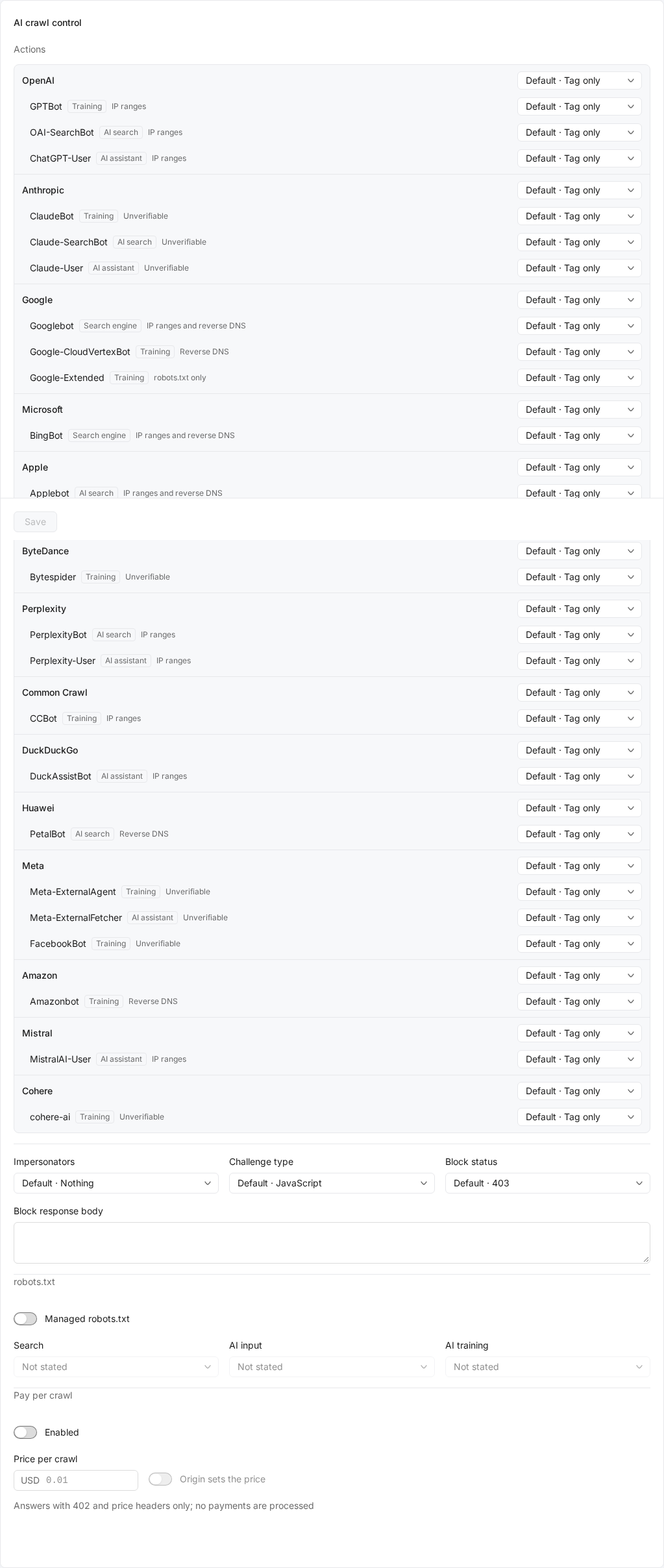
Catalogue
| Operator | Crawlers | Purpose | Verification |
|---|---|---|---|
| OpenAI | GPTBot, OAI-SearchBot, ChatGPT-User | Training, AI search, assistant | Published ranges |
| Anthropic | ClaudeBot, Claude-SearchBot, Claude-User | Training, AI search, assistant | Unverifiable |
| Googlebot, Google-CloudVertexBot, Google-Extended | Search engine, training | Published ranges / reverse DNS; Google-Extended is a robots.txt token only | |
| Microsoft | BingBot | Search engine | Published ranges / reverse DNS |
| Apple | Applebot, Applebot-Extended | AI search, training | Published ranges / reverse DNS; Applebot-Extended is a robots.txt token only |
| ByteDance | Bytespider | Training | Unverifiable |
| Perplexity | PerplexityBot, Perplexity-User | AI search, assistant | Published ranges |
| Common Crawl | CCBot | Training | Published ranges |
| DuckDuckGo | DuckAssistBot | Assistant | Published ranges |
| Huawei | PetalBot | AI search | Reverse DNS |
| Meta | Meta-ExternalAgent, Meta-ExternalFetcher, FacebookBot | Training, assistant | Unverifiable |
| Amazon | Amazonbot | Training | Reverse DNS |
| Mistral | MistralAI-User | Assistant | Published ranges |
| Cohere | cohere-ai | Training | Unverifiable |
robots.txt tokens (Google-Extended, Applebot-Extended) never appear in requests: they take allow or block only, and block goes into the managed robots.txt.
Actions
| Action | What the node does |
|---|---|
| Allow | Forwards to the origin. Verified crawlers also skip Under Attack and CC challenges. |
| Block | Answers 403 (the built-in error page) or 402, optionally with your text. X-Edgeweir-Error: ai-crawler-blocked. |
| Challenge | Challenges with the chosen type; a pass of that level lets the request through. |
| Charge | Pay per crawl; blocks while pay per crawl is off. |
Order: the site's crawler action → the site's operator action → the global crawler action → the global operator action. Block, challenge and charge apply to every claimant, whatever the verification; the Impersonators setting (none / block / challenge) also applies to failed verifications, and a blocked crawler stays blocked.
/robots.txt is never blocked or challenged. Actions run after the site's rules; allow rules, rules that skip challenges, allow lists and ACME validation are unaffected. Blocks are logged with the block reason ai_crawler, pay per crawl refusals with pay_per_crawl.
Settings
- Global: Protection settings → Protection → AI crawlers. With Detect AI crawlers on, nodes tag crawlers in access logs and statistics; here you set every site's default actions, impersonators, challenge type and block response. Saving publishes every cluster.
- Site: Sites → (site) → Security → AI crawlers, the AI crawl control card. Override the global actions per crawler or operator; impersonators, challenge type and block response can follow the global settings. Saving hot-updates the site's cluster.
The cluster's active nodes need ai-crawlers-v1; detection alone does not.
Managed robots.txt
When on, the console writes the text below and the node puts it before the origin's robots.txt on delivery:
# BEGIN Edgeweir managed content
User-agent: *
Content-Signal: search=yes, ai-train=no
Allow: /

User-agent: GPTBot
Disallow: /

# END Edgeweir managed content- The
Content-Signalline appears only when a content signal (search, ai-input, ai-train: yes / no) is set. - Each blocked or challenged crawler gets a
Disallow: /group; charged crawlers do not. - Only
GET/HEADof exactly/robots.txt: prepended when the origin answers 200 plain text without content encoding; alone for a 404, 410 or a 200 that is not text (an application's fallback page). - The node drops
Accept-Encoding,Rangeand conditional request headers when it fetches the file; the edge compresses the merged file as the site's compression settings say. The change happens on delivery: the cache keeps the origin's file.
Pay per crawl
With pay per crawl on and a price set (USD 0.001–1000), crawlers set to Charge get:
| Request | Response |
|---|---|
| No price header | 402, crawler-price: USD 0.01, crawler-error: MissingCrawlerPrice |
crawler-exact-price differs from the price | 402, InvalidCrawlerExactPrice |
crawler-max-price below the price | 402, InvalidCrawlerMaxPrice |
| Both price headers | 400, ConflictingPriceHeaders |
| Malformed price | 400, InvalidCrawlerPriceValue |
| Unverified crawler with a price header | 400, StrongAuthRequired |
| Acceptable price, origin answers 2xx | The response with crawler-charged: USD 0.01; access logs and statistics record the charge |
Prices are USD with up to 6 decimals. /robots.txt, /sitemap.xml, /security.txt, /.well-known/security.txt and /crawlers.json are free. Only verified crawlers can pay.
Origin sets the price: the origin sets a response's price in its crawler-price response header (without it, the site's price applies); a malformed value gives 502 InvalidContentPrice. crawler-price reaches clients only on a 402.
Nodes record charges and collect nothing; settlement needs a payment provider, which Edgeweir does not include.
Overview
Sites → (site) → AI crawlers, AI crawler traffic, filtered by range, operator and crawler:
| Item | Meaning |
|---|---|
| Requests | Requests that claimed an AI crawler, against the previous range of the same length |
| Allowed / Failed | Status below 400 and not refused / the rest (refused, 4xx, 5xx) |
| Blocked | Refused by AI crawler actions (block, challenge, pay per crawl) |
| Bytes | Bytes sent to crawlers |
| Charged | Requests sent with crawler-charged and their amount |
| robots.txt | robots.txt requests |
| Crawler cards | Grouped by operator: each crawler's requests, allowed and failed, verified / impersonator / unverifiable |
| Top paths | Approximate: each node keeps its 64 heaviest paths a minute |
The access log's Crawler column and filter show the claimed crawler, its verification and the amount charged.
Limits
- No Web Bot Auth signature verification (it needs the operators' key directories at runtime), no
cf-pay-per-crawlrequest header. - Published ranges are refreshed before console releases (
pnpm --filter @edgeweir/contract ai-crawlers:ranges); ranges an operator adds later fail verification until the next release. - Blocking and charging unverifiable crawlers relies on the User-Agent: an impersonator escapes a charge by not claiming the crawler.
Troubleshooting
| Symptom | Check |
|---|---|
| A real crawler shows as an impersonator | Whether its address is in this release's published ranges (new ranges from the operator); whether reverse DNS works from the node |
| robots.txt lacks the managed text | Whether the origin answers 200 text/plain; whether the site sets a content signal or blocks / challenges a crawler |
| Settings cannot be saved | Upgrade the cluster's active nodes to a version with ai-crawlers-v1 |
| The overview shows little | The unsupported node count on the page; older nodes report no crawler statistics |
Challenges and CC mitigation
Make visitors pass a challenge first: by rule, per site or globally (Under Attack), or escalating with load (tiered CC); a pass admits them until it expires.
OWASP CRS managed rules
Turn on the OWASP Core Rule Set (CRS) per site: ModSecurity on the nodes inspects requests, records the rules they match, and in block mode refuses attacks.